 Tulum Cenotes
Laguna Kaan Luum: Price, Hours and the Cenote in the Middle
Laguna Kaan Luum is the shallow turquoise lagoon south of Tulum with a deep cenote at its centre, and it is the odd stop on a cenote itinerary: you wade rather than swim, the water is warm rather than cold, and the part that gives the place its shape is roped off. Entry is reported at MX$300 to MX$350 for foreign visitors in 2026, cash only. Here is what to expect, and how it compares with the Tulum cenotes tour options that reach the cavern cenotes.
Quick answer What Kaan Luum costs, why the middle is roped off, and who it suits
Entry is reported at MX$300 to MX$350 for a foreign visitor in 2026, cash only, with lower rates for Mexican nationals and Quintana Roo residents. Laguna Kaan Luum is a shallow lagoon a few kilometres south of Tulum: you wade a long way in warm, milky turquoise water that rarely passes waist height, and the dark circle in the middle — a cenote reported at around 85 metres deep — is roped off and closed to swimmers. Hours are roughly 09:00 to 17:00, moving with the season.
Key takeaways
- MX$300 to MX$350 reported for foreign visitors in 2026; less for Mexican nationals and Quintana Roo residents
- The deep centre is roped off - swimming there is not allowed and it is a dive site, not a swim
- Shallow, warm and sandy for most of its width, which makes it the easiest water near Tulum for small children
- Flying a drone is charged separately, reported at about MX$150
- It is a lagoon, not a cenote swim - for the cavern look, Gran Cenote or Dos Ojos
What Laguna Kaan Luum Is
A lagoon with a cenote in the middle
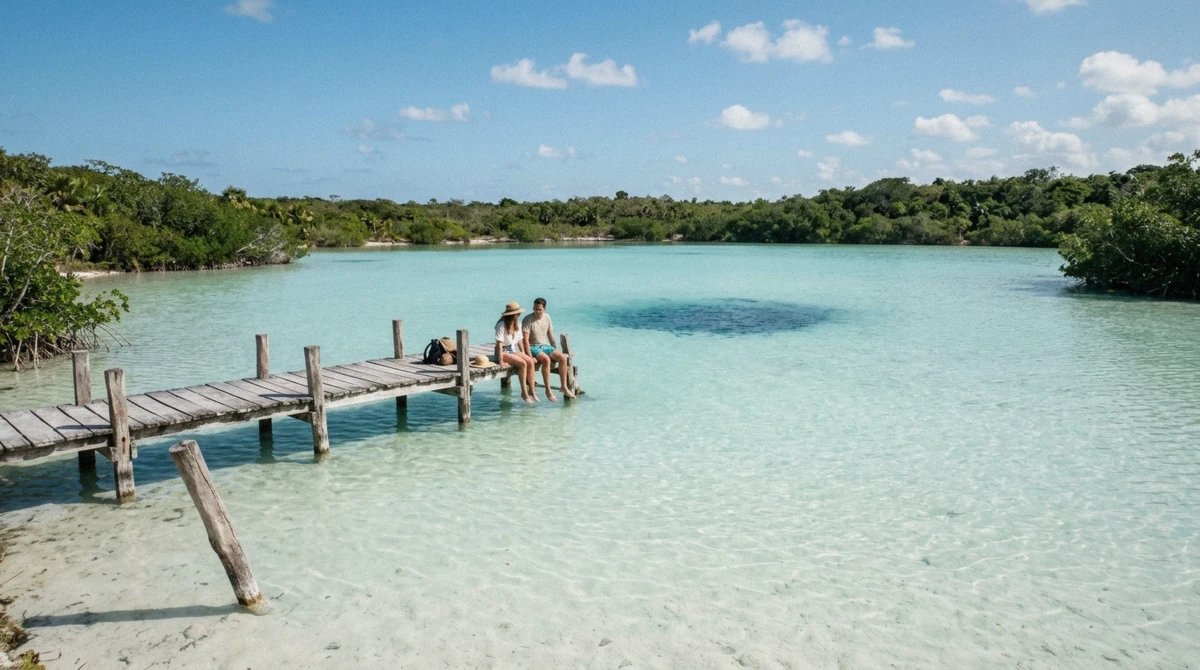
The lagoon is wide, shallow and floored with pale marl that turns the water an opaque turquoise you can see from the air. Wade out a long way and it stays around knee to waist depth, which is why the photographs from here look like someone standing on the surface of the water.
In the centre the floor drops away into a cenote reported at about 85 metres deep, and that part is roped off. Swimming into it is not permitted; it is a technical dive site rather than a swim, and the rope is the boundary between the two.
Why the water looks like that
Fine white sediment suspended over a dark opening produces the two-tone effect: milky pale blue in the shallows, ink-dark over the drop. It is not a filter, and it is also why underwater visibility here is poor compared with a cavern cenote - you are looking at suspended marl rather than through clear fresh water.
Come for the colour and the wading. If you want to see rock formations under water, this is the wrong stop.
Who it suits, and who should skip it
It suits families with small children, anyone who does not swim confidently, and anyone who wants an afternoon of standing in warm water with a drink rather than climbing into a cold shaft. Hammocks, jetties and swings along the shore are set up for exactly that.
Skip it if you have one cenote day and want the classic image: a shaft of light in a cavern. That is Gran Cenote or the bright eye at Dos Ojos, and neither looks anything like this.
What the name means and how the lagoon formed
Kaan Luum is Yucatec Maya, usually rendered as yellow earth, and the lagoon is what happens when a cenote collapses into a wide shallow basin rather than a narrow shaft. The pale floor is marl - fine carbonate sediment washed off the limestone - and it is that layer, not the depth, that produces the milky turquoise.
The dark circle at the centre is the original cenote, still open into the aquifer below. Everything around it is the collapsed rim, filled with sediment over thousands of years, which is why you can wade for a hundred metres and then run out of floor entirely.
What people get wrong about it
Two things, both from photographs. The first is scale: the drone shots that made this place famous flatten a wide, busy lagoon into a neat blue eye, and at ground level it looks like a large warm pond with a rope across the middle. The second is the swimming - visitors arrive expecting to swim in the deep blue centre and find it closed.
Booked with those two corrections in place, it delivers exactly what it is: shallow warm water, hammocks, shade and an easy afternoon twenty minutes from town.
Prices, Hours and Getting There
Kaan Luum publishes no tariff online, so the figures below are what visitors and guides reported through 2026. The tiered pricing by nationality is unusual near Tulum and worth knowing before you reach the window.
What people paid in 2026
Reports cluster between MX$300 and MX$350 for a foreign adult, with lower rates cited for Mexican nationals and Quintana Roo residents. Drone flying is charged separately. Bring pesos in cash: like most gates around Tulum, there is no card terminal and no cash machine.
| What | Reported figure | Note |
|---|---|---|
| Foreign adult entry | MX$300 to MX$350 | 2026 visitor reports; no published tariff |
| Mexican nationals | About MX$200 | Reported; ID asked for at the window |
| Quintana Roo residents | About MX$150 | Reported; ID asked for at the window |
| Drone | About MX$150 extra | Charged separately from entry |
| Hours | About 09:00 to 17:00 | Reported to shorten to 16:30 in low season and stretch to 18:00 in high season |
Getting there
The lagoon sits a few kilometres south of Tulum town off Highway 307, a short taxi ride or a manageable cycle on a quiet stretch. Colectivos heading south will drop you at the turn-off; from there it is a walk in on a dirt track.
There is no organised transport and no tour on this site that stops here. If you have a car it is a natural pairing with an afternoon in Tulum town; if you do not, factor the taxi both ways into the cost.
What to bring
Cash, a hat, water, and biodegradable sunscreen applied after you swim rather than before. There is shade along the shore and very little in the middle of the lagoon, and the shallow water gets warm rather than cooling you down.
Water shoes help: the bottom is soft in places and there are roots and branches near the shore.
How it compares with the cenotes nearby
Kaan Luum is priced like a cenote and behaves like a beach, which is the source of most disappointed reviews. The table sets it against the three places people usually consider instead, so the trade is explicit before you pay at the window.
| Where | Price | What you actually do | Best for |
|---|---|---|---|
| Laguna Kaan Luum | MX$300-350 reported | Wade in warm shallow water; the deep centre is closed | Small children, non-swimmers, an easy afternoon |
| Gran Cenote | About MX$500 reported | Snorkel a cavern with turtles and stalactites | The classic cenote photograph |
| Cenote Zacil-Ha | About MX$300 reported | Swim a small clear pool, zip line, hammocks | A relaxed second stop with children |
| Dos Ojos | MX$400 published | Snorkel two joined sinkholes; guided cavern extra | Knowing the price before you leave town |
What a morning here looks like
Arrive at opening, pay in cash, and walk out along the jetty or wade straight in. The shallow water is warm from first light, the shore has hammocks, swings and shade, and most people spend two to three hours here rather than the forty-five minutes a cenote stop takes.
By midday the shallows are busy and the light is flat, which matters here more than at a cavern cenote - the colour that makes this place worth the entry money is a morning effect.
Sargassum, rain and the season
The lagoon is inland and fed by fresh water, so the sargassum that lands on the Caribbean beaches does not reach it. Rain is the variable that does: heavy downpours stir the fine marl and the turquoise turns grey for a day or two, which is worth knowing in the wet months of June, September and October, when Tulum averages 195, 182 and 199 millimetres.
The cave cenotes are indifferent to that. This one is not.
Kaan Luum Among the Others
Useful for the contrast: the lagoon's flat turquoise next to the cavern cenotes that make up the rest of a Tulum cenote day.
Where Laguna Kaan Luum Is
A few kilometres south of Tulum town, inland from Highway 307 down a short dirt access road.
Laguna Kaan Luum: Questions Before You Go
How much does it cost to enter Kaan Luum Lagoon?
Reports through 2026 put foreign adult entry at MX$300 to MX$350, with about MX$200 for Mexican nationals and MX$150 for Quintana Roo residents, and roughly MX$150 more to fly a drone. There is no published tariff, so bring cash in pesos and treat those as a range.
Is it safe to swim in Laguna Kaan Luum?
The shallow lagoon is about as safe as open water gets: knee to waist depth over a soft floor, warm, with no current. The deep cenote in the middle is roped off and closed to swimmers - that boundary is the one rule that matters here, and it exists because the drop is reported at around 85 metres.
How deep is the cenote at Kaan Luum?
Reported at about 85 metres in the centre of the lagoon. It is a dive site for qualified divers rather than a swim, and the roped-off zone marks where the shallow floor ends.
What are the opening hours?
Around 09:00 to 17:00, with reports of 16:30 closes in low season and 18:00 in high season. As everywhere near Tulum, the first hour after opening is the quiet one.
Is Kaan Luum good for children?
It is the easiest water near Tulum for small children: shallow for a long way out, warm, no stairs into a shaft and no cold shock. Keep them well clear of the roped centre, and bring water shoes for the soft bottom.
Can you fly a drone at Kaan Luum?
Yes, with a separate charge reported at about MX$150. The lagoon is one of the few places near Tulum where drone photography is expressly priced rather than banned - Parque Dos Ojos, for example, requires prior permission.