 Tulum Cenotes
Cenote Calavera Tulum: Price, the Jump and What Is Below
Cenote Calavera Tulum is the skull cenote on the Coba road, a kilometre and a half out of town: three holes in flat limestone, one of them wide enough to jump through, and a wooden ladder for everyone else. Below is a single open chamber about 19 metres deep with a halocline that dive shops run as a short cavern dive. Entry is reported at MX$250 to MX$300 in 2026, cash only. Here is what to expect, and how it fits with the rest of a Tulum cenotes tour day.
Quick answer The jumping cenote: price, the drop, and the halocline underneath
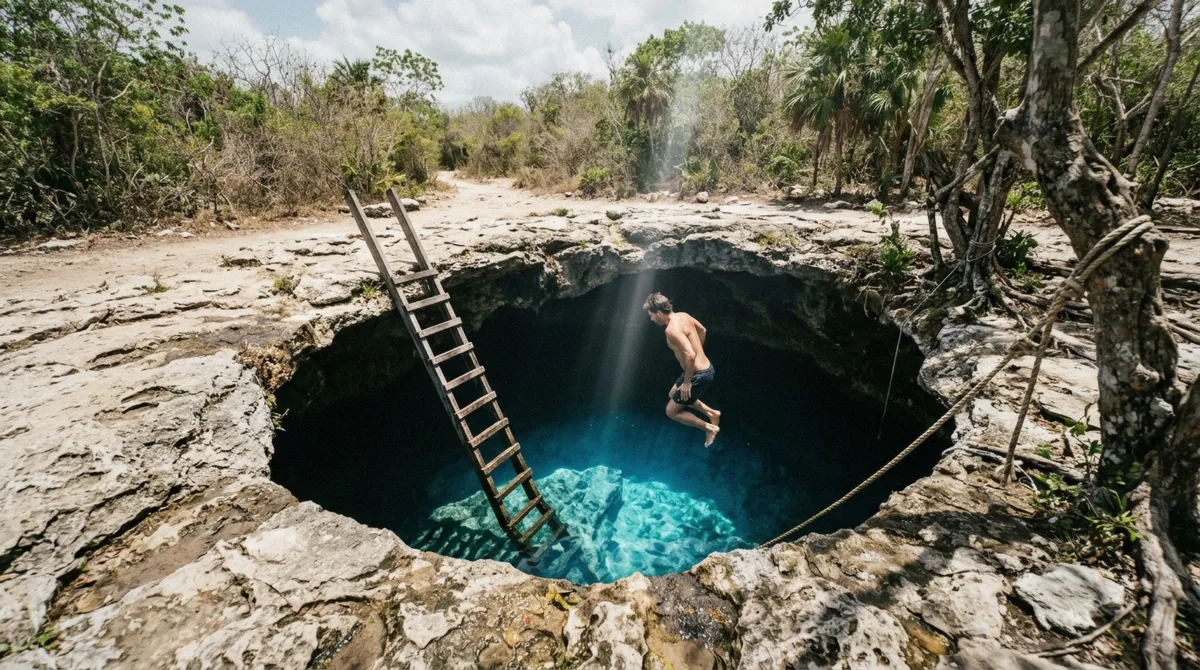
Cenote Calavera is the skull cenote: three holes in flat limestone about a kilometre and a half out of Tulum town on the Coba road, one wide enough to jump through and two smaller ones that make the skull. A wooden ladder drops through the main opening for anyone who would rather climb. Below is an open chamber about 19 metres at its deepest, with a halocline that makes it a favourite short cavern dive. Entry is reported at MX$250 to MX$300 in 2026 with a life vest about MX$50 extra, cash only, and hours around 09:00 to 17:00.
Key takeaways
- MX$250 to MX$300 reported, plus about MX$50 for a life vest - cash, no card machine
- The jump is the point; the ladder is there for everyone else
- About 19 metres at its deepest, with a halocline divers come for
- Closest of the famous cenotes to Tulum town - walkable at a push, five minutes by bike
- For a cavern swim rather than a jump, Gran Cenote is three kilometres further on
What Cenote Calavera Is
Three holes in the ground
From above it is unremarkable: flat rock, scrub, a dirt path and three openings. The largest is wide enough to jump through, and the two smaller ones beside it are the eye sockets that give the cenote its name - calavera means skull.
The drop into the water is a few metres and the landing is deep. A wooden ladder runs through the main hole for anyone who prefers to climb, and plenty of visitors do exactly that, swim, and never jump at all.
What it looks like from the water
A single open chamber, lit by three shafts coming through the holes, with a rope hanging in the middle and the roof close overhead at the edges. It is smaller than the photographs suggest and it fills quickly - twenty people in that chamber is busy.
Depth reaches about 19 metres, which is why it is a cavern dive as well as a swim, and why the jump feels safe once you know the number.
The halocline underneath
Below the fresh water sits a denser salt layer, and the boundary between them shimmers - the same effect Casa Cenote is known for, but here it is inside a chamber rather than an open channel. Dive operators run Calavera as a short guided cavern dive for that reason.
Snorkellers see the top of it as a wobble in the water. Divers swim through it.
Who should skip the jump
Anyone unsure about landing in deep water, anyone travelling with small children, and anyone who would rather not have to climb a wet ladder back out. There is no shallow shelf to stand on in the chamber.
The easy alternatives on the same road are Zacil-Ha, which is shallow and has a pool beside it, and Gran Cenote, which has stairs and platforms.
Diving Calavera, and why operators like it
For divers the appeal is the shape: a single chamber with three light shafts, a halocline to swim through and a maximum depth of about 19 metres, all within two minutes of the road. That makes it a short, cheap cavern dive that pairs well with a second cenote in the same morning, and Tulum dive shops sell it exactly that way.
The same features make it a poor first dive. There is no shallow shelf, the entry is a jump or a ladder, and the chamber walls close in at the edges. Beginners are better served by an open-water lagoon dive with an instructor.
What people get wrong about it
That it is big. The photographs shoot upward through the holes and make the chamber look cathedral-sized; in practice it is one room, and a busy afternoon fills it.
The second misunderstanding is the jump. Nobody is required to do it, the ladder is right there, and the water below is deep enough that the drop is the easy part - climbing back out of a cenote with no shelf is what surprises people.
Prices, Hours and Getting There
No published tariff here either, so these are 2026 visitor and guide reports. Prices on this road moved upward through the year, which is worth knowing before you arrive with exact change.
What people paid
Reports put adult entry at MX$250 to MX$300 with a life vest about MX$50 on top, cash only. Several 2026 write-ups note cenote prices around Tulum rising through the year, so treat the lower end as optimistic.
| What | Reported figure | Note |
|---|---|---|
| Adult entry | MX$250 to MX$300 | 2026 reports; cash only, no cash machine |
| Life vest | About MX$50 | Charged separately |
| Hours | 09:00 to 17:00, seven days | Reported |
| Maximum depth | About 19 metres | Cavern dive site as well as a swim |
| Distance from Tulum town | About 1.5 km on the Coba road | The closest of the well-known cenotes |
Getting there
It is the first cenote you reach heading out of Tulum town on the Coba road, close enough to cycle in five to ten minutes or walk if you are determined and it is not midday. A colectivo on that road costs MX$30 to MX$50.
Because it is so close, it is the easiest cenote to fit around something else - an early swim before the ruins, or a stop on the way back from Gran Cenote.
Diving it
Calavera is sold as a guided cavern dive by Tulum dive shops, usually paired with another cenote in a two-tank day. Certification is required, as everywhere in an overhead environment.
If you are not certified, the equivalent on this site is a supervised first dive in an open cenote, which teaches you in half an hour and keeps four divers to one instructor.
Where to jump near Tulum
Calavera is the best-known jumping cenote but not the only one, and the heights differ more than the photographs suggest. Published figures come from Parque Dos Ojos; the rest are reported.
| Where | The drop | Price | Note |
|---|---|---|---|
| Cenote Calavera | One main hole plus two small ones, a few metres down to deep water | MX$250-300 plus vest, reported | A ladder runs through the main hole for everyone else |
| Cenote Jaguar, Parque Dos Ojos | Platforms at 1.5 m and 3 m | MX$250, published | Also has a zip line; part of the same park as Dos Ojos |
| Cenote Zemway | Tiered platforms | Included on the private morning | The quietest of the three |
| Cenote Zacil-Ha | No jump; zip line instead | About MX$300, reported | The easy alternative on the same road |
The practical bits
There is a changing area and somewhere to leave a bag, and nothing else. No restaurant, no cash machine, no gear rental beyond the life vest.
Go early. The chamber is small, the light shafts through the three holes are the reason to photograph it, and by late morning there are enough people in the water that the shafts are full of swimmers rather than light.
Fitting it into a day
Because it is the closest of the well-known cenotes to town, Calavera works as a first stop before Gran Cenote or as a short swim at the end of an afternoon. Twenty minutes here is enough to jump, swim and climb out.
What it does not work as is the single cenote of a trip: one chamber, one jump, no cavern to swim through. Pair it with something on the same road.
Safety, plainly
The jump is into deep water with no shelf, so anyone who cannot swim confidently should use the ladder and wear the vest. Wet limestone around the rim is slippery, and the ladder rungs are wet by definition.
The cenote is small enough that everyone in the water can see everyone else, which is its own safety feature. Go early, do not jump on top of another swimmer, and treat the rope in the middle as something to hold rather than to swing from.
Where Cenote Calavera Is
About a kilometre and a half northwest of Tulum town on the Coba road - the first of the well-known cenotes as you leave town.
Cenote Calavera: Questions Before You Go
How much is Cenote Calavera?
Reports through 2026 put adult entry at MX$250 to MX$300, with a life vest about MX$50 extra. Cash only, no card terminal and no cash machine at the gate.
How deep is Cenote Calavera?
About 19 metres at its deepest. That depth, and the halocline where fresh water meets salt, is why dive shops run it as a short guided cavern dive as well as a swimming cenote.
Do you have to jump in at Cenote Calavera?
No. A wooden ladder runs through the main hole and plenty of visitors use it, swim, and leave without jumping. There is no shallow shelf inside the chamber, though, so everyone in the water is swimming rather than standing.
Why is it called the skull cenote?
Calavera means skull. Three openings in the flat limestone - one large and two small beside it - look like a skull's eye sockets from above, which is also why some operators list it as the Temple of Doom.
How far is Cenote Calavera from Tulum?
About a kilometre and a half on the Coba road, the closest of the well-known cenotes to town: five to ten minutes by bike, a short taxi, or MX$30 to MX$50 in a colectivo.